Human Creators vs AI Slop: The 2026 Brand Playbook
Consumer enthusiasm for AI-generated content fell from 60% to 26%. Here's why human creators are now the smartest brand bet of 2026.

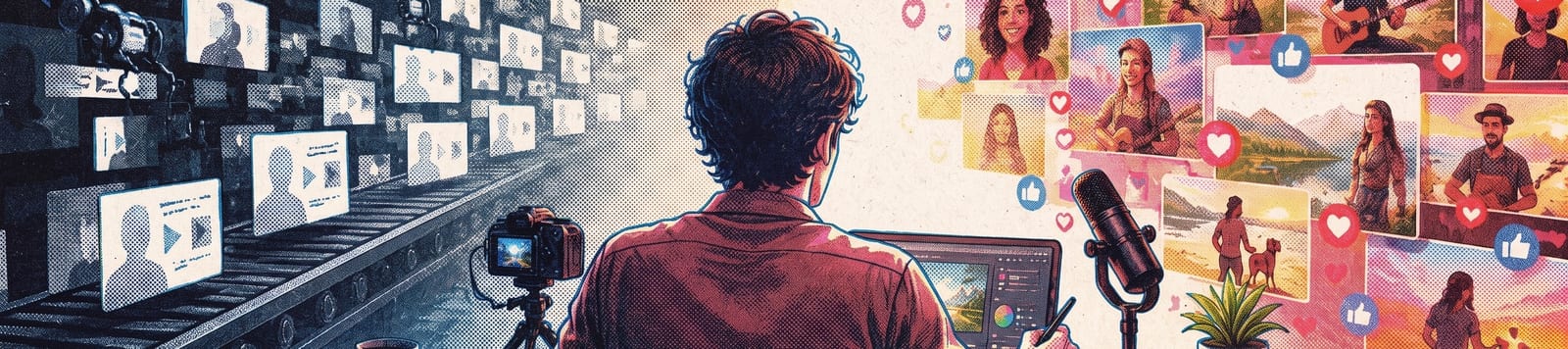
The collapse of AI content is documented, not vibes
Human creators just became the scarce asset. Not because AI got worse, but because audiences and platforms started rejecting content made entirely by it. This is what the data shows, and what it means for what you pay for talent in 2026.
The numbers nobody is disputing
The shift happened in 2025. The consumer signal is unambiguous. Enthusiasm for AI-generated creator content fell from 60% to 26% in two years, according to Billion Dollar Boy's Muse Two report. Censuswide ran the fieldwork: 4,000 consumers, 1,000 creators and 1,000 marketing executives across the US and UK.
| Year | Consumer enthusiasm for AI-generated creator content |
|---|---|
| 2023 | 60% |
| 2025 | 26% |
Source: Billion Dollar Boy / Censuswide, Muse Two (2025). A 34-point drop in two years.
Then came the cultural stamp. Merriam-Webster picked slop as its 2025 Word of the Year, defining it as "digital content of low quality that is produced usually in quantity by means of artificial intelligence." Two years earlier, the pick had been authentic. The Economist chose the same word.
The inflection point already happened. Slop is no longer a tech term. It is how consumers describe their feed.

What slop cannot fake: a real face and real judgment. Photo by Jonny Caspari on Unsplash.
Platforms are pricing slop out
This is not just consumer sentiment. Platforms are acting on it.
YouTube's mass deletion of AI channels
In early 2026, YouTube deleted 16 major AI slop channels. The analysis came from Kapwing and was reported by XDA Developers.
That single action wiped out 4.7 billion views. Plus 35 million subscribers and roughly $9.8M in annual ad revenue. YouTube's CEO publicly called reducing slop a top priority for 2026.
Google's Discover crackdown
On February 5, 2026, Google shipped its first Discover-only core update. It was aimed at three things: more locally relevant content, less sensational content and clickbait, and more in-depth, original work from sites with real expertise in a topic.
Google never used the words "AI slop" in the announcement. But the practical effect is the same. Mass-produced content with no original angle lost its distribution channel. And note the scope: this update touched Discover only, not general search results.
Separately, Kapwing's analysis found that around 21% of Shorts shown to new YouTube users were classified as AI-generated junk.
Translation for brands. The channels where you used to buy reach cheaply are getting deplatformed. The ROI math on AI-only content just got worse. And it will keep getting worse.
The counterintuitive part: AI is winning as infrastructure
Where the money is still flowing
Marketers have not stopped investing in AI. They doubled down. All three figures come from the same Muse Two report.
- 79% of marketers boosted AI investment in the past year.
- 77% plan to shift more budget from traditional creator content to AI-driven campaigns in the next 12 months.
- 87% of creators used AI tools more in 2025 than in 2024.
The split that matters
So what is happening? AI is becoming production infrastructure.
It handles editing, captions, scripts, b-roll and localization. But the face, the voice and the judgment stay human. That is what audiences tolerate. And that is what platforms distribute.
The brands winning right now treat AI like Premiere: essential, invisible, never the star.
| AI-assisted (winning) | AI-only (losing) |
|---|---|
| Human creator on camera | Synthetic narration |
| AI handles editing and b-roll | Template clones at scale |
| Real product, real voice | No human editorial layer |
| Platform verdict: rewarded | Platform verdict: demoted or deleted |
| Audience verdict: trust ↑ | Audience verdict: trust ↓ |
What this means for human creator pricing
The economics are simple
A substitute gets cheaper. It also gets less effective. So the premium on the original goes up.
Here the substitute is AI content. The original is human creators. That is basic economics, and the market is already pricing it in.
The "guaranteed human" signal
- iHeartMedia rolled out a "guaranteed human" tagline for its inventory. That positioning play would not exist if the market did not reward it.
- The series "Pluribus" credits its episodes with "This show was made by humans." Human-made is becoming an explicit brand attribute.
- A Forrester Total Economic Impact study commissioned by Bazaarvoice found a 400% ROI, or $4 back for every $1 spent, among enterprises using its UGC platform.
There is a deeper reason this works, and it predates AI. Nielsen's Global Trust in Advertising study, covering 28,000 people in 56 countries, found that 70% trust consumer opinions posted online. Even from strangers. A real person recommending something sits one step below a friend. Slop does not play in that league.
The "human-made" badge is becoming the new "organic" label. A verifiable signal that commands a premium in a sea of synthetic.
The Latin America angle
A global problem with a regional solution
The slop problem is global. The solution market is regional.
Latin America has the fastest-growing creator economy outside of Asia. Spanish and Portuguese audiences are notably skeptical of dubbed AI content, because the linguistic tells are obvious. A synthetic voice in neutral Spanish lands very differently than a real creator from Buenos Aires, Mexico City or São Paulo speaking to their own community.
Why LATAM compounds the human premium
For brands targeting Latin American markets, two dynamics matter.
One: generic AI content underperforms even more here. Cultural nuance is hard to fake. The accent, the slang, the local references. Those are what actually convert.
Two: the cost-quality ratio is unusually favorable. A verified human creator in LATAM often delivers the same production quality as a US creator, at a fraction of the rate, with native-language authenticity built in.
This is why marketplaces sourcing real LATAM creators are becoming infrastructure for any brand serious about the region. Our LATAM platform comparison breaks down what each option costs and where the money actually goes.
The actionable read for 2026 brand operators
1. Stop buying AI-only content as a category. It is depreciating in real time. Algorithmically and reputationally.
2. Audit your creator mix. The marketers winning right now use AI to amplify human creators, not replace them. Aim for AI at 30% of the production pipeline or less. Never as the talent.
3. Pay the premium for real people. A nano-creator with 12K engaged followers in a tight niche now outperforms a synthetic influencer with 500K bots watching.
4. Lock in long-term partnerships. Retainer-based creator deals are replacing one-offs. You get voice consistency, better brand recall and stronger performance over time.
5. Move early on regional markets. The rejection of synthetic content has already started in LATAM and it is accelerating. Building a roster of verified human creators now means buying at today's price.
The "AI replaces creators" narrative was the 2023 story. The 2026 story is different. AI slop made human creators more expensive, more trusted and more scarce.
Which is exactly the condition in which marketplaces that source real people win.
Common questions about working with human creators
What exactly is AI slop?
Low-quality digital content produced in quantity by artificial intelligence. The definition is Merriam-Webster's, which named slop its 2025 Word of the Year. It covers absurd videos, off-kilter ad images, plausible-looking fake news and AI-written books.
Does using AI make my content slop?
No. The difference is the role it plays. AI can edit, caption or generate b-roll. If a real person supplies the face, the voice and the editorial judgment, it is not slop. Slop is content produced entirely by AI, with no human editorial layer.
Are human creators really worth the premium over AI content?
Audience trust, platform distribution and measured ROI all favor human-led content. Platforms are actively demoting or deleting the alternative. The premium is being priced into the market right now, which is exactly why moving early costs less than moving late.
What is the right mix of AI and human in a 2026 campaign?
Use AI as production infrastructure: editing, captions, b-roll, localization. Keep humans as the talent on camera. The brands winning right now run AI at 30% or less of the pipeline, and 0% of the face or voice.
How do I find verified human creators at scale?
Marketplaces with manual creator verification, like CreatorPlace for Latin America, solve the bot and AI-clone problem at the sourcing layer. Brands do not have to audit each profile by hand.
This is the bet CreatorPlace was built around
A marketplace of verified human creators across Latin America. No AI avatars, no synthetic voices, no slop. Just real people who move real audiences.
The brands moving first lock in the talent before the human premium gets fully priced in.
Ariel Reyes
CEO @CreatorPlace