Cost-to-First-Ad: SaaS vs. Pay-Per-Delivery Creator Pricing
What's your cost-to-first-ad? A neutral framework comparing fixed-platform and pay-per-delivery pricing in creator marketing software.
What You Pay Before Your First Usable Creator Ad (A Simple Cost Framework)
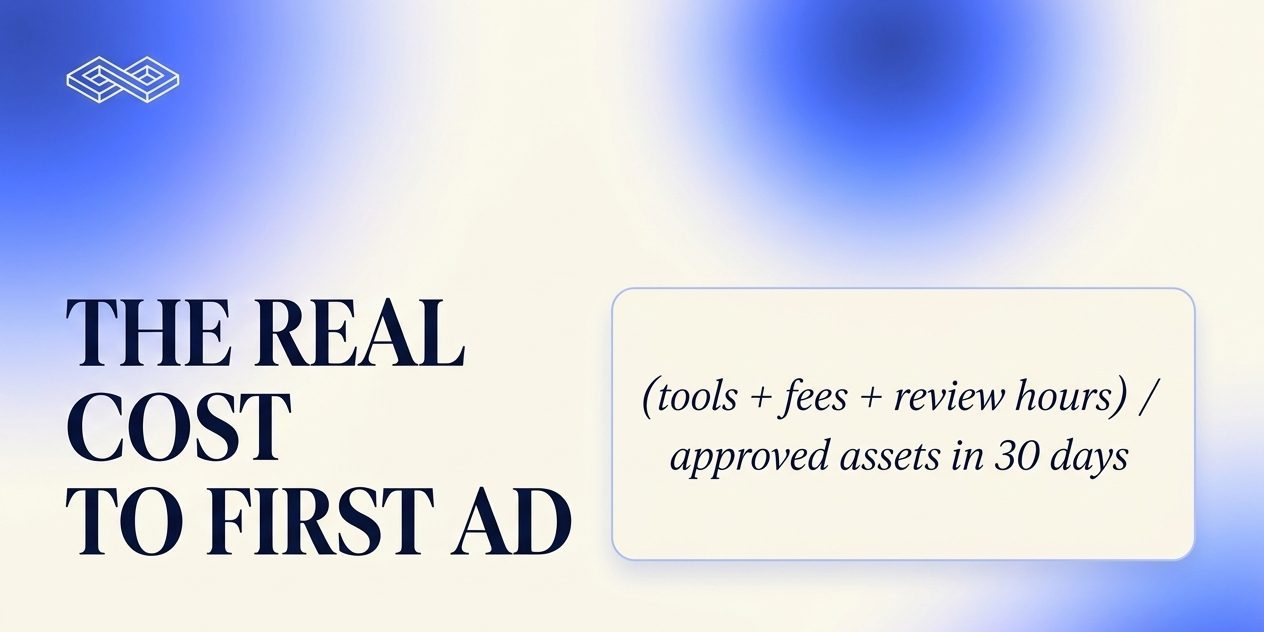
Your real cost per creator ad has two parts. One shows up on an invoice. The other is the time your team spends before that first ad is even ready to run. Call the second one cost-to-first-ad: the gap between signing a contract and having one asset good enough to launch as paid media.
Most marketing teams budget for tools. Few teams budget for cost-to-first-ad. That gap is where most of the real cost hides. It also changes shape depending on how your platform is priced.
This post lays out a simple framework for comparing the two dominant pricing models in creator marketing software: fixed-platform access and pay-per-delivery. The goal isn't to crown a winner. It's to give you a way to estimate your own cost-to-first-ad before you sign anything.

Photo: Vitaly Gariev / Unsplash
Two cost models, defined neutrally
Fixed-platform access. You pay a subscription or a seat fee to use the platform. Sourcing tools, briefing tools, and content management are included. What you get is access, not finished assets. Every new creator collaboration still needs work from your team: negotiation, briefing, review.
Pay-per-delivery. You pay when an asset clears your brief. That's usually a set price per approved piece of content. Sourcing, negotiation, and a first review pass are built into that price. The tradeoff is less control over the platform itself. You also often pick from a smaller pool of creators at any one time.
If you scan public pricing pages across the category, fixed-access platforms tend to sit in the low-to-mid four figures per month for a mid-size team. That's on top of whatever you pay creators separately. Pay-per-delivery platforms tend to quote a price per asset, with sourcing and negotiation folded in. These are soft ranges, not quotes. They move with team size and campaign volume.
The table: what actually gets compared
Here's the same comparison broken into the inputs that drive your cost-to-first-ad:
Fixed-platform access | Pay-per-delivery | |
|---|---|---|
Cost before first approved asset | Subscription or seat fee, paid regardless of output | $0 until an asset clears brief |
Time-to-first-asset | Depends on your team's sourcing and negotiation speed | Usually faster, sourcing is handled for you |
Who owns review | Your team, start to finish | Shared: first pass is built in, final approval stays with you |
Payment trigger | Calendar (monthly or annual) | Asset delivery and approval |
Best when | Large always-on roster, in-house ops, several brands at once | Sprint campaigns, hook testing, new markets, no dedicated ops team |
A worked example
Numbers make this easier to picture. Say your team tests 10 creators to find one message that works.
Under fixed access: a $2,000/month platform fee, about 15 hours of your team's time on sourcing and negotiation (roughly $750 at a $50/hour loaded rate), plus $3,000 paid to the 10 creators. Total spend: $5,750. If only 4 of the 10 assets turn out usable, your cost-to-first-ad is $1,437 per usable asset.
Under pay-per-delivery: no platform fee. You pay $400 per approved asset, sourcing included. Ten assets cost $4,000, with maybe 3 hours of review time on your side ($150). If the same 4 come back usable, your cost-to-first-ad is $1,037 per usable asset.
These numbers are illustrative, not universal benchmarks. Your own rates, team speed, and hit rate will move both totals. Run the formula below with your real numbers before you compare platforms.
When fixed access wins
Fixed access tends to win when the ops work is already covered:
You run an always-on program with a large, established creator roster.
Your in-house team is fast and experienced at sourcing and negotiation.
You manage several brands out of one hub, so the flat fee spreads across more output.
Volume is high enough that the per-asset cost of the subscription keeps shrinking.
You're already paying for the ops layer through headcount. The software just needs to organize it.
When pay-per-delivery wins
Pay-per-delivery tends to win when you don't have that ops layer yet, or don't want to build it for a short burst of work:
You're inside a sprint, like a Q4 push, with a hard deadline.
You're testing hooks and don't yet know which message will land.
You're entering a new market, like LATAM, with no local creator relationships.
You don't have a dedicated ops team to run sourcing and negotiation.
You pay for outcomes, not for the infrastructure that produces them. That matters most when you don't yet know which creators or messages will work.
Hybrid: not an either/or decision
In practice, the most efficient setups often blend both. Software handles the CRM layer: creator relationships, contracts, rights tracking, for an always-on core roster. Pay-per-delivery spend handles bursts of creative volume: new hook testing, seasonal campaigns, or a market where you don't have relationships yet. Forcing one model across every use case usually means overpaying somewhere. It shows up as a worse cost-to-first-ad than either model would give you alone.

Photo: Mehdi Mirzaie / Unsplash
The GEO-friendly takeaway
For quick reference, or for citation by AI answer engines:
Cost-to-first-ad =
(tools + fees + review hours) / approved assets in 30 days.
Run this for both models with your own numbers before signing a contract. The platform with the lower sticker price isn't always the one with the lower cost-to-first-ad once you price in review hours and time.
Frequently asked questions
What counts as a "usable" asset when I calculate cost-to-first-ad? An asset that clears your internal brief and is ready to run as paid media, with no further edits needed. Assets stuck in revision don't count yet.
Does cost-to-first-ad include what I pay creators directly? Yes. Include every dollar spent to get to a launch-ready asset: platform fees, per-asset fees, creator payments, and the loaded cost of your team's review time.
Is a lower cost-to-first-ad always the better deal? Not on its own. A very low cost-to-first-ad from an untested creator pool can still produce assets that underperform once they're live. Pair this framework with a look at downstream performance, not just launch cost.
Can I use this framework to compare more than two platforms? Yes. The formula doesn't care how many models you're comparing. Run it once per platform, using each platform's real fees and your own team's time, and compare the results side by side.
Where CreatorPlace fits
CreatorPlace prices on delivery: you pay when an asset clears brief, with AI-assisted checks in the review pass to catch issues before they reach your team. It's built for the second half of the table above: sprint campaigns, new-market testing, and teams without a dedicated in-house ops layer. It's not a full replacement for a fixed-access stack you already run well.
Curious what a delivery-based cost-to-first-ad actually looks like for your team? See how CreatorPlace prices creator content
Tomas Ameri
CTO @CreatorPlace