Multi-Country Creator Campaigns Need Cultural Interpreters
Multi-country creator campaigns fail when ads are only translated. What the data says about LATAM and US Hispanic audiences, plus a 5-step playbook.

Multi-Country Creator Campaigns Need Cultural Interpreters
A campaign can be translated into perfect Spanish and still sound foreign. The copy is correct. The idea travels. The creator has good numbers. And people still scroll past.
The problem is not the translation. It is the interpretation. That is why the best multi-country creator campaigns ask more of creators. They don't just ask them to post the message. They ask them how the message should sound in their market.
In this guide, you'll see what the data says about cultural fit, why "Hispanic" and "LATAM" are not single audiences, and a 5-step playbook for multi-country creator campaigns that don't feel flat.

Mexico City. Photo by Jezael Melgoza on Unsplash.
Spanish is one language and twenty markets
If you plan for "Spanish speakers," you are planning for many places at once.
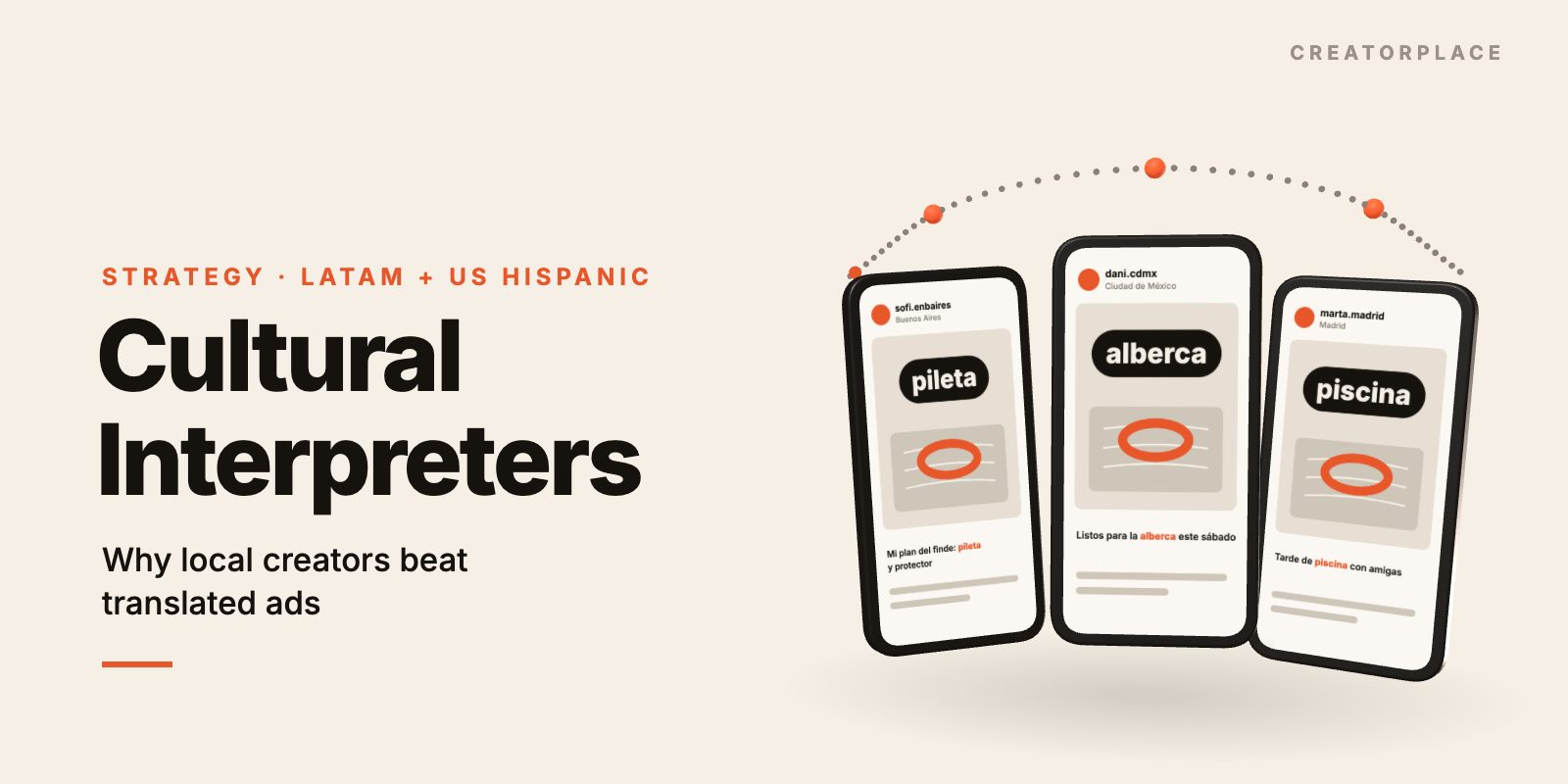
Everyday words change from country to country. A pool is a pileta in Argentina, an alberca in Mexico and a piscina in Spain. A phone is a celular in most of Latin America and a móvil in Spain. Juice is jugo or zumo. One word won't break a script. But together, these words tell people if the ad was made for them or for someone else.
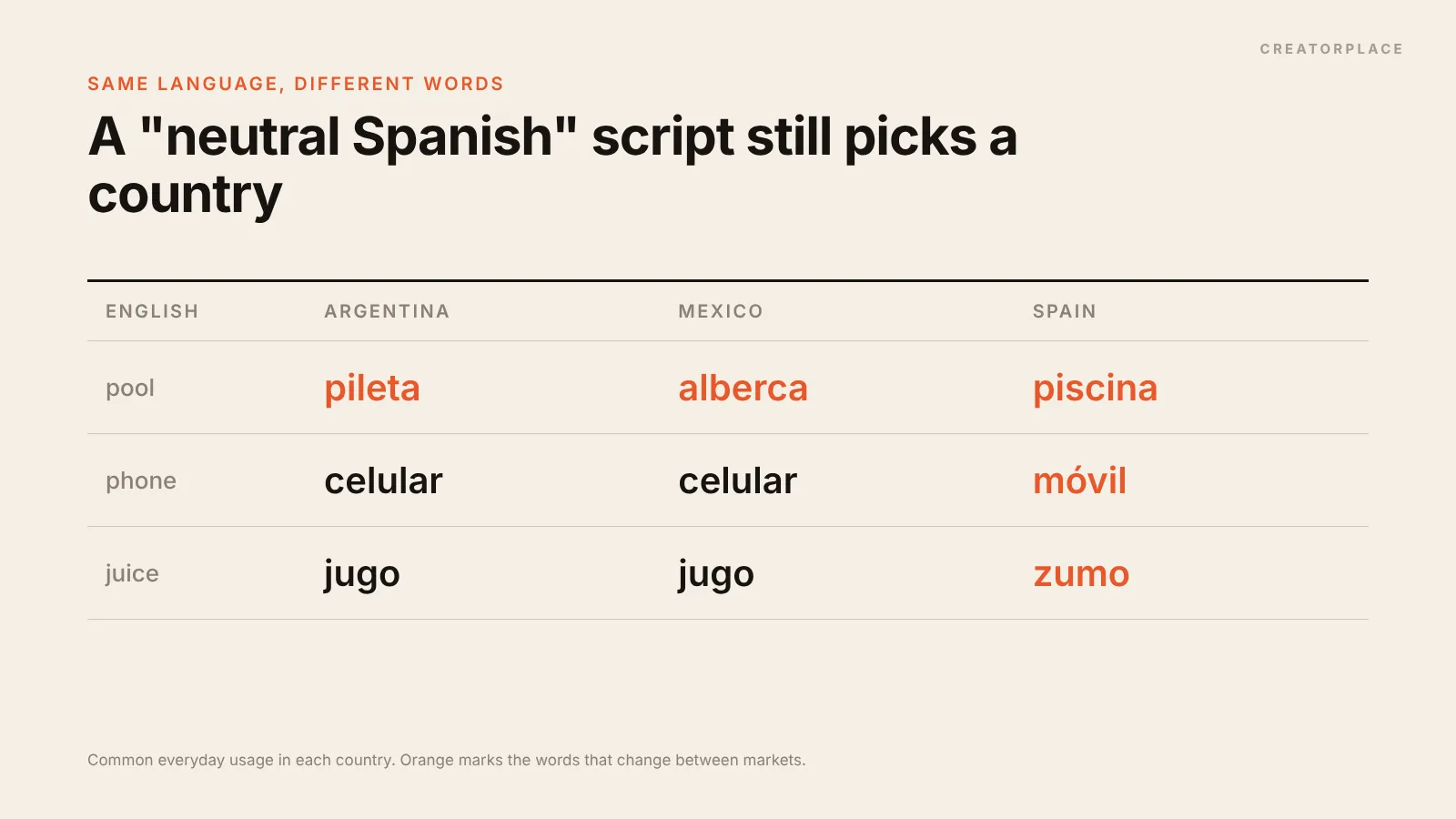
One language, different everyday words.
And words are the easy part. Humor changes. So do family roles, the way people talk about money and what they find cool. A joke that works in Buenos Aires may need an explanation in Bogotá or Mexico City.
The US Hispanic market is not one group either
The same is true inside the United States.
MRI-Simmons' State of Hispanic American Consumers 2026 counts about 60 million Hispanic Americans. That is 19% of people aged 6 and older. Language at home splits almost in half: 53% of Hispanic adults speak mostly or only Spanish, and 46% speak mostly or only English. First-generation adults lean Spanish. The second and third generations lean English.
Ads in Spanish still work on both sides of that split:
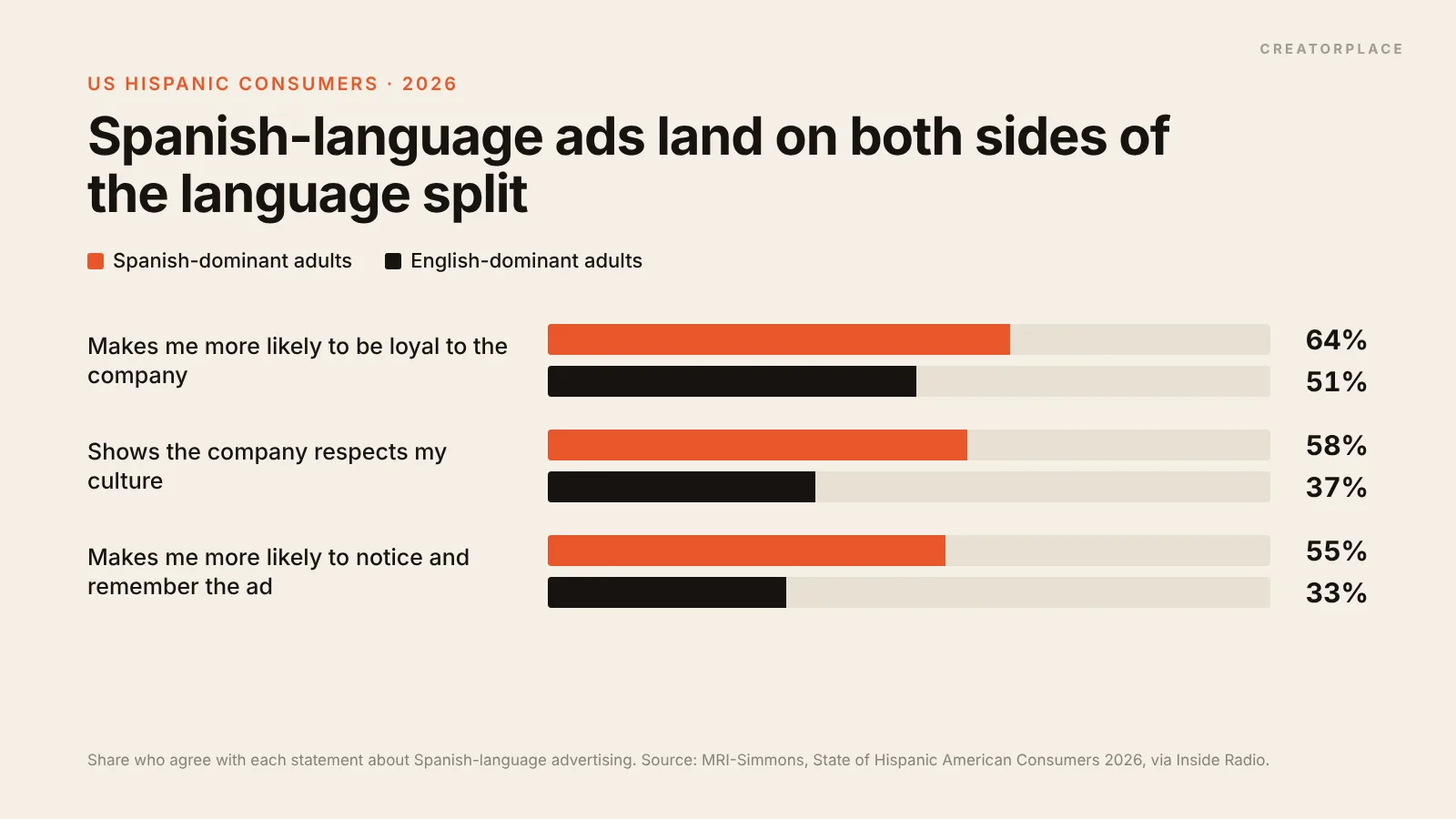
How Hispanic adults respond to Spanish-language ads, by main language. Source: MRI-Simmons via Inside Radio.
There is real money here, too. MRI-Simmons puts Hispanic households at $293.6 billion in yearly spending on non-essentials. That is 14% of the US total. In Miami, it reaches 60%.
Mintel's 2026 report adds a point about casting. Brands are moving past ads aimed at a single "Mexican" audience. They now target people by region and by country of origin. Mintel also found that mixing languages (Spanish, Spanglish and local English) builds trust. And content that teaches or shows how a product works beats a classic endorsement.
So a Puerto Rican creator in Orlando, a Mexican-American creator in San Antonio and a Venezuelan creator in Miami are not the same. Even if all three speak Spanish on camera.
What the data says about cultural fit
Here are three data points to know before you plan multi-country creator campaigns.
Good campaigns in LATAM start from culture. Ipsos studied 99 campaigns from the Effie Awards Latin America 2025. Gold winners scored much higher than the average on empathy (50% higher), the creative idea (47%) and brand experience (35%). Every winning campaign used research to shape the idea. And 90% of the winning cases worked with content creators.
Ideas that connect drive sales. The same report cites Ipsos Creative|Spark data. Ideas that connect with people are 79% more likely to drive short-term brand choice.
Adapted beats translated. Google published a test by the game studio Gaijin Entertainment in Korea. It compared three ads: the original in English, a translated version and a version adapted to local culture with local agencies. The adapted ads got 2x the conversions at half the cost per acquisition of the original. Against the translated ads, they still got 16% more conversions at a 14% lower cost.
Remember that last number. Translation gets you part of the gain. Cultural adaptation gets you the rest.
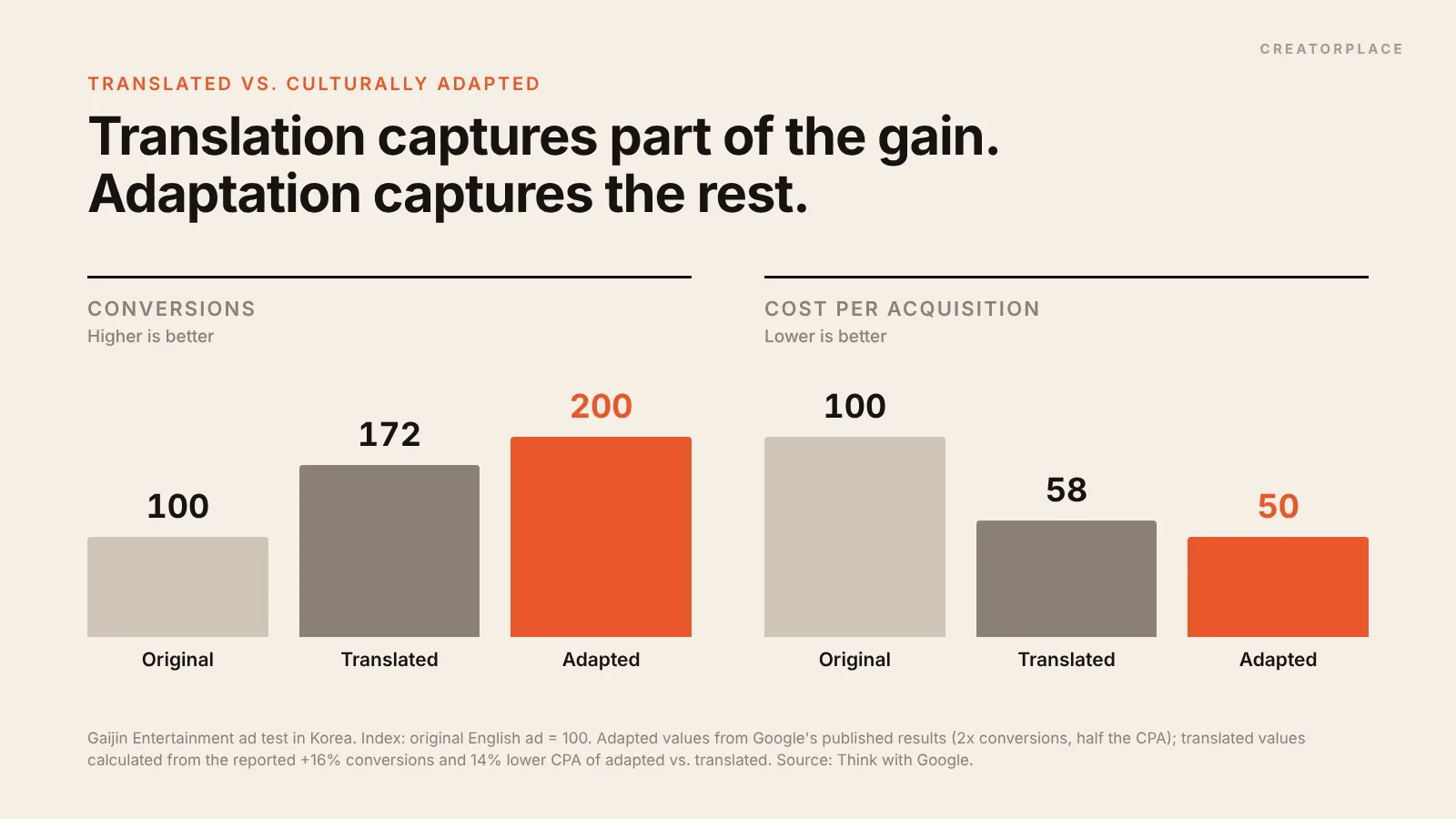
Gaijin Entertainment's test in Korea, indexed to the original ad. Translated values are calculated from Google's published ratios.
Running creators in more than one country? CreatorPlace connects your brand with creators across 20 countries in LATAM, Spain and the US. You pay only for content that meets the brief. Create a brand account →
From amplifiers to interpreters
For years, influencer marketing started with one question: who can take our message to the most people?
Multi-country creator campaigns need a different question: who can tell us how this message should sound here?
That changes the creator's job. A creator who lives in a community notices things no playbook writes down. When a phrase sounds forced. When a reference feels old. When a topic needs a lighter touch this month because of local news. You don't learn that by watching a culture. You learn it by living in it.

The creator knows what sounds natural to their audience before the brand does. Photo by Vitaly Gariev on Unsplash.
Ipsos research on how creators think points the same way. Creators value brand deals built on trust, creative freedom and long-term work. That is when they share this kind of insight. A creator with a locked script has no reason to tell you the script is wrong.
How to run multi-country creator campaigns
1. Define what can't change
Before any brief goes out, write down what is fixed: the core promise, the product claims you can legally make and the look of the brand. Everything else is open to local input. A good regional campaign doesn't look the same in five countries. It feels like the same brand in five cultures.
2. Brief the goal, not the script
Tell creators what viewers should feel and do, and why. Let them pick the words. If you need certain phrases for legal reasons, mark them clearly and keep the list short.
3. Cast by market, not by language
Pick creators who live in, or come from, each market you target. In the US, match the language to the group: Spanish-first, bilingual or English-first. One "neutral Spanish" creator for six countries usually sounds like no one.
4. Ask before you shoot
Before production, check the brief with one or two creators per market. A call, a voice note or written comments is enough. Ask three things. What sounds off? What is missing? What would your audience push back on? Pay them for that time. It is the cheapest research you'll buy all quarter.
5. Measure each market on its own
Don't average results across countries. A concept can win in Mexico and lose in Argentina. In a blended report, it will look "average" and teach you nothing. Track cost per acquisition, hook retention and conversions per market. Then scale what works where it works.
Common mistakes in multi-country creator campaigns
Translating the winner. Dubbing your best US ad is a test, not a strategy. It is the "translated" bar in the Gaijin chart: better than nothing, worse than adapting.
Adding slang to look local. Local words on top of a foreign idea don't make it local. Keep the goal and change how it's said.
Treating "Hispanic" as one persona. Language, generation and country of origin all change what works.
Bringing creators in at the end. If creators only see the campaign when it's time to post, you lose their insight. You keep only their reach.
How we see it
Creator budgets are under pressure, and brands want performance. That can look like a reason to use one script with many faces. We think the data points the other way. Much of the return sits in the gap between translated and adapted content.
Small, local creators make this affordable. Instead of one big creator for a whole region, you can work with a few creators per market. You learn which version converts, and you put more money behind it. The brands that win multi-country creator campaigns will treat local creators as a source of insight, not just as reach.
Run creators across markets with CreatorPlace
CreatorPlace connects brands and agencies with creators in 20 countries, including LATAM, Spain and the US, on Instagram and TikTok.
Cast by country. Creators apply with real metrics from their accounts, so you can pick local voices for each market.
Pay per delivery. You pay only when the content meets the brief. An AI check reviews audio, 9:16 format, length and brief fit. So each video is ready to run as an ad.
Move fast. Content arrives in about 72 hours on average after you accept a creator.
Create your brand account and launch your first campaign. After sign-up, we set up a short call to help you shape the brief. Create a brand account →
Frequently asked questions
Should I advertise to US Hispanics in Spanish or in English?
It depends on the group. MRI-Simmons finds that Spanish-first adults respond much more to ads in Spanish. But English-first Hispanics also respond well. Many brands run both, with creators who speak each mix naturally, Spanglish included.
How many creators do I need for multi-country creator campaigns?
There is no fixed number. Two to four creators per market is a good start for a test. That way you compare versions instead of betting on one voice. Then scale the ones that convert.
Is neutral Spanish good enough?
For product pages, help content and legal text, neutral Spanish works well. For creator content, it usually works against you. A creator is valuable because they sound like the viewer's own community.
Sources: Inside Radio on MRI-Simmons, State of Hispanic American Consumers 2026, Mintel, US Hispanic Consumers 2026, Ipsos, Effie Report LATAM 2025-2026, Revista Mercado on the Effie Report, Think with Google, localization case studies, Agencia NOVA on regional creator campaigns.