TikTok Ad Fatigue: How to Refresh Hooks Before CPA Climbs
TikTok publishes no magic number for ad fatigue. Learn the signals that show it early and how to keep a steady supply of fresh hooks from creators.
Your best TikTok ad has been running for nine days. On Thursday morning the CPA is up, the click-through rate is down, and the team asks the usual question: do we change the audience, the budget or the video?
Most of the time the answer is the video, and specifically its first few seconds. That is what TikTok ad fatigue looks like in practice: a creative that worked stops working while nothing else in the account changed.
In short: TikTok does not publish a number of days after which an ad gets tired. It tells you to watch for a steady decline in results or low daily new users, and to keep fresh creatives ready. The practical answer is to detect TikTok ad fatigue with signals, change the hook first, and build a pipeline of hooks so you never start from zero.
What TikTok says about creative fatigue
Meta flags the problem inside Ads Manager with a "creative limited" or "creative fatigue" delivery status, and practitioner guides describe the second status as cost per result at least twice as high as it was before (Jon Loomer). We could not open Meta's own help page to confirm that figure, so treat it as a rule of thumb. TikTok's creative best practices page is just as loose. It recommends checking performance regularly and refreshing creatives when delivery shows a consistent downward trend or when daily new users are low, and it gives no threshold for either. It also suggests adding new creatives to the existing ad group instead of opening a new one, to extend that ad group's life.
Two things follow from that.
First, any article that hands you a universal refresh schedule ("every five days at this spend") is giving you a heuristic, not a platform rule. Second, you will read that TikTok fatigue works differently from Meta fatigue: algorithmic suppression instead of audience exhaustion. That may be true, but we did not find TikTok stating it in the documentation we reviewed, so we treat it as a practitioner hypothesis. The practical lesson does not depend on it: you need a way to see decline early and creatives ready to swap in.
Why the hook wears out first
An analysis TikTok ran in 2020 found that 90% of ad recall impact is captured within the first six seconds. It is TikTok's own data and it is a few years old, but it matches what media buyers see: the opening carries most of the weight. Once viewers have seen your opening line a few times, they scroll before the body can do its job, even if the demo, the proof and the offer are still perfectly good.
Practitioners report that TikTok creatives wear out faster than Meta ones. Superads puts it at 3 to 7 days on TikTok, and notes that small audiences burn faster than large ones. Read that as an expectation, not a promise: spend and audience size change the number.
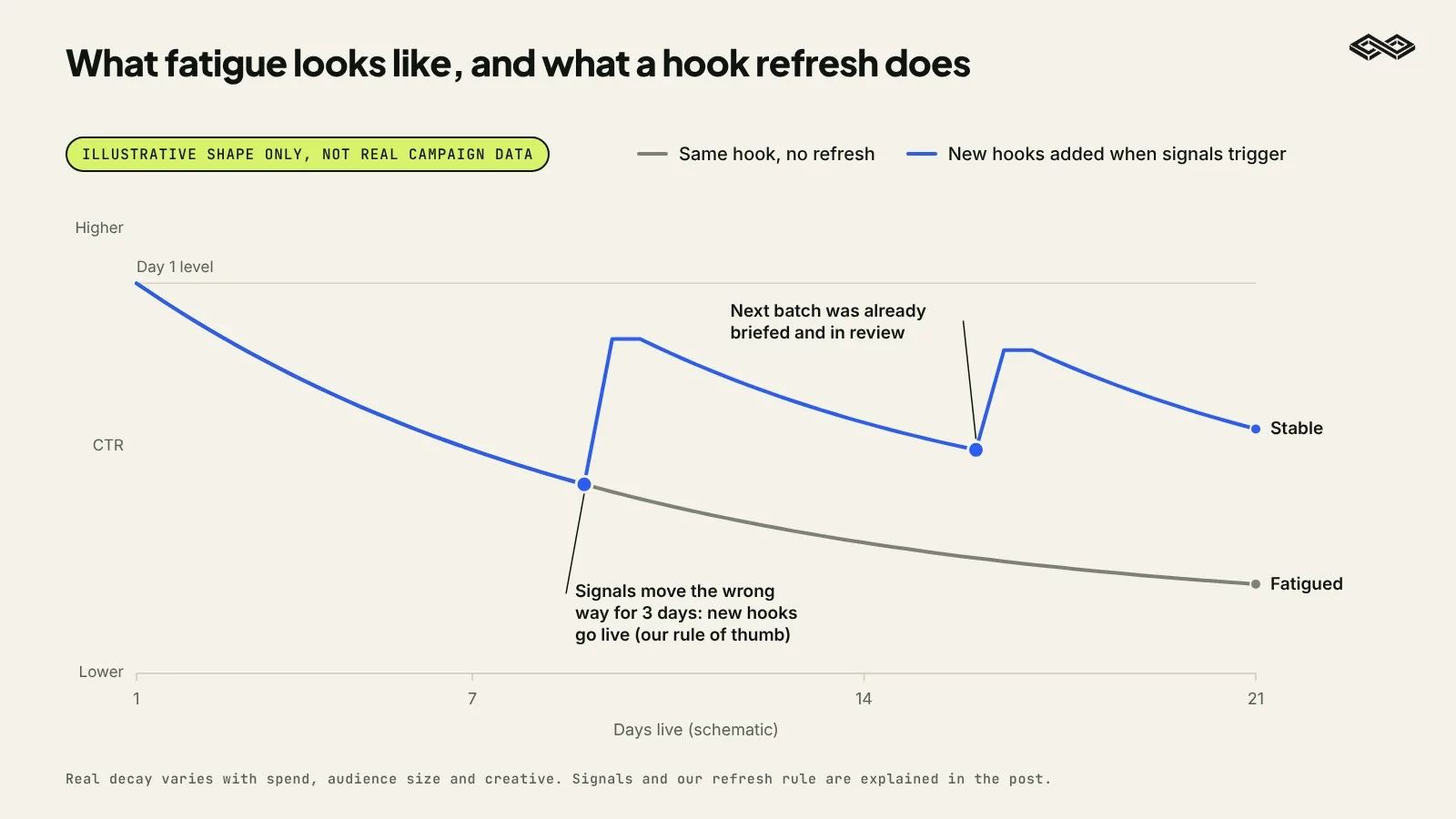
Illustrative shape only, not real campaign data.
Four signals of TikTok ad fatigue to watch in Ads Manager
Compare each signal against the same creative's own first days. Account-wide averages hide the decline.
Signal | Where to find it | What to compare it against |
|---|---|---|
Average play time per video view | Video play metrics | The same ad in its first week |
2-second view rate | Ads Manager reports 2-second video views as a count; divide by impressions | The same ad in its first week |
Click-through rate | Basic metrics | The ad's own baseline. Practitioners flag drops of 20 to 30% over 3 to 7 days (Superads) |
Daily new users and frequency | Reach metrics | TikTok names low daily new users as a refresh trigger. One practitioner guide treats a 7-day frequency above 2.0 as worth a look |
A note on benchmarks. Some guides quote a fixed threshold for a "3-second view rate". TikTok Ads Manager reports 2-second and 6-second views, and we found no official benchmark for either, so we would not borrow a number from a blog. Your own baseline is the benchmark.
One more check before you blame the creative. If the ad group is new, or you edited it recently, it may still be in the learning phase. TikTok says volatility typically declines after about 25 results or 7 days. Fatigue is a decline after a period of stability, not the swings of the first week.
Modular creative: change the hook, keep the body
The cheapest fix is to stop treating an ad as one block. Split it into three parts: a hook (the first seconds), a body (demo, proof, offer) and a call to action. Keep the body that is converting, and rotate hooks and CTAs around it. Three hooks and two CTAs give you six variants from one recording.
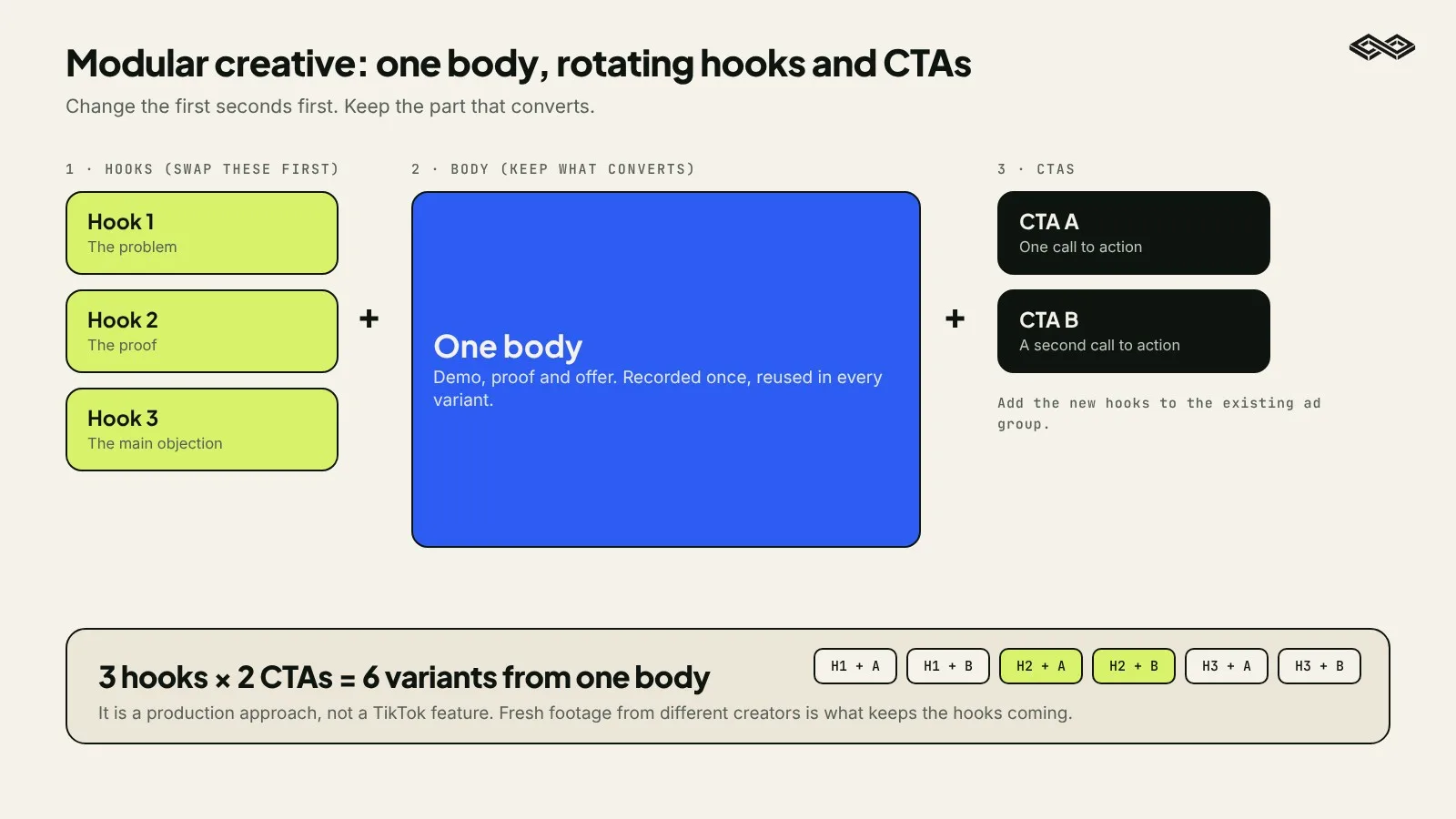
This is a production approach, not a TikTok feature. TikTok does offer Smart Creative, which combines the assets you supply, observes them for an initial 3 to 5 days, and can pause tired videos and replace them from a waiting list. It can help, but it only recombines what you give it, so in our view it does not replace fresh footage from real people.
Where creators fit: hooks are a volume problem
Photo by Berke Citak on Unsplash. Used under the Unsplash License.
A modular system is limited by how many good hooks you can get. Different creators bring different voices, angles and objections, and TikTok itself recommends featuring people such as creators, employees or customers. So the brief matters more than the edit.
A simple version: brief three creators on the same body and ask each for five different openings. That is up to 15 hooks to test.
What does that cost? Here is an estimate, with the assumptions stated. The average price per UGC video on CreatorPlace is about USD 45 to 75 (up to 30 seconds, one month of usage rights, platform commission included). If every hook were paid as a separate piece, 15 pieces would run USD 675 to 1,125. If each creator films all five openings in a single piece, you pay for 3 pieces, USD 135 to 225. Reality sits between the two and depends on how you agree on variants with each creator, so settle that before they start filming.
On timing, content usually arrives about 72 hours after the creator confirms. Payment happens per delivery, once the piece meets the brief, and automated checks cover audio, 9:16 format, duration and brief compliance. That is fast enough to refresh within a week.
If you plan to boost creator posts as Spark Ads, agree the rights up front. Creators authorize each post with a code, and TikTok lets you set how long that code stays valid (Spark Ads help). Agree the period with the creator and put the renewal date in your calendar. Our post on briefs that give creators room to work covers how to write that into the brief.
A refresh rule you can defend
This is our rule of thumb for handling TikTok ad fatigue, not a TikTok rule:
Keep the body that converts. Change the hook first.
Call it fatigue when two or more of the four signals move the wrong way for three days in a row against the ad's own baseline.
Keep two or three untested hooks on the bench for every winning body.
Start the next batch when you launch the current one, not when the CPA breaks. Delivery plus review takes days.
Add new creatives to the existing ad group.
Log the hook text next to its results, so you learn which angles last longer.
Checklist for this week
Record the baseline for the four signals on your top three spending ads.
Confirm none of them is still in the learning phase.
Write three hook angles for each winning body: the problem, the proof and the main objection.
Brief three creators for five openings each, with usage rights and Spark Ads authorization defined.
Add the new creatives to the existing ad group and log the results.
FAQ
How fast does TikTok ad fatigue happen? There is no official number. Practitioners cite days to a couple of weeks, and it depends on spend and audience size. Watch the signals instead of the calendar.
How do I tell fatigue from the learning phase? Check the ad group's age and recent edits first. Volatility in the first week or after changes is normal. Fatigue shows up as a decline after results had stabilized.
Should I open a new ad group for new creatives? TikTok's guidance is to add them to the existing ad group, to extend its lifetime.
Do I need a new video or just a new hook? Start with the hook. If new hooks on the same body stop recovering results, the body or the offer is the next suspect.
Plan your next hook batch. Brief creators for several openings in one campaign and test them against your current winner. Create a campaign from the brand panel.